
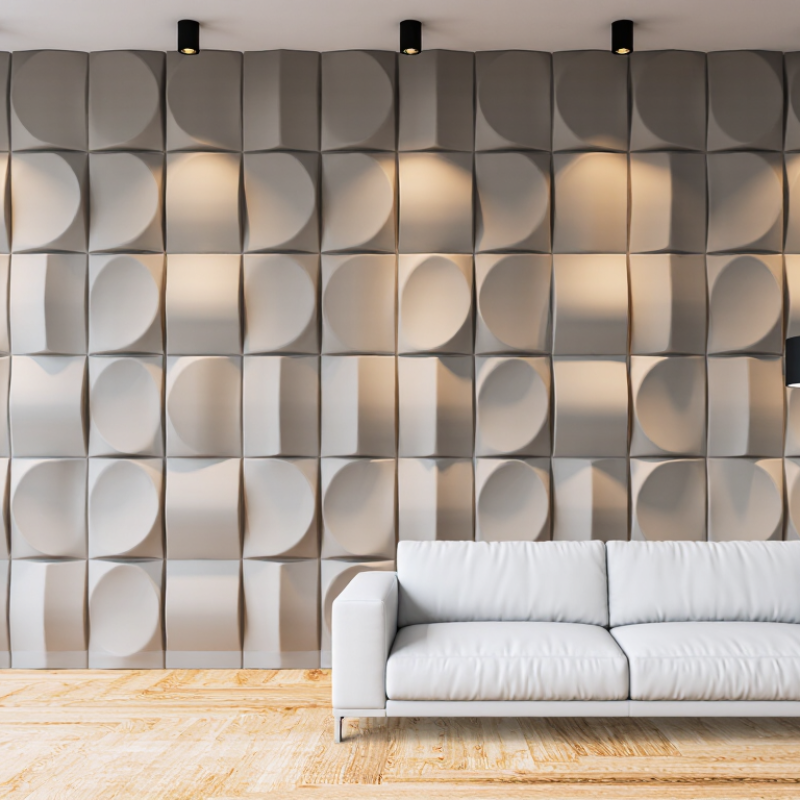
A WPC 3D wall panel gets its depth from shaped tooling, not from a printed image. Its wood fibers and thermoplastic resin are heated, blended, and pushed through a profile die. The USDA Forest Products Laboratory’s technical review reports that wood content in WPC formulations commonly ranges from about 30% to 70% by weight. That variation affects flow, surface detail, and how consistently a pattern forms.
During production, a patterned roller can press grooves, grain lines, or shallow ridges into the warm surface. Some profiles are shaped directly by a mold or die. Small changes in pressure, temperature, or fiber distribution can soften sharp details. Not magic. It is controlled forming, with material behavior that still needs monitoring. A neat wood-grain texture may look regular under showroom lights, yet reveal uneven ridges when sunlight crosses the panel.
Manufacturers check the relief depth, panel thickness, and surface finish across production runs. Deep grooves can collect dust, while very fine patterns may disappear after finishing. Grand View Research estimated the global WPC market at about US$7.4 billion in 2023, but that broad market figure does not indicate how precisely any individual panel is made. A sample viewed at an angle is still worth inspecting.