
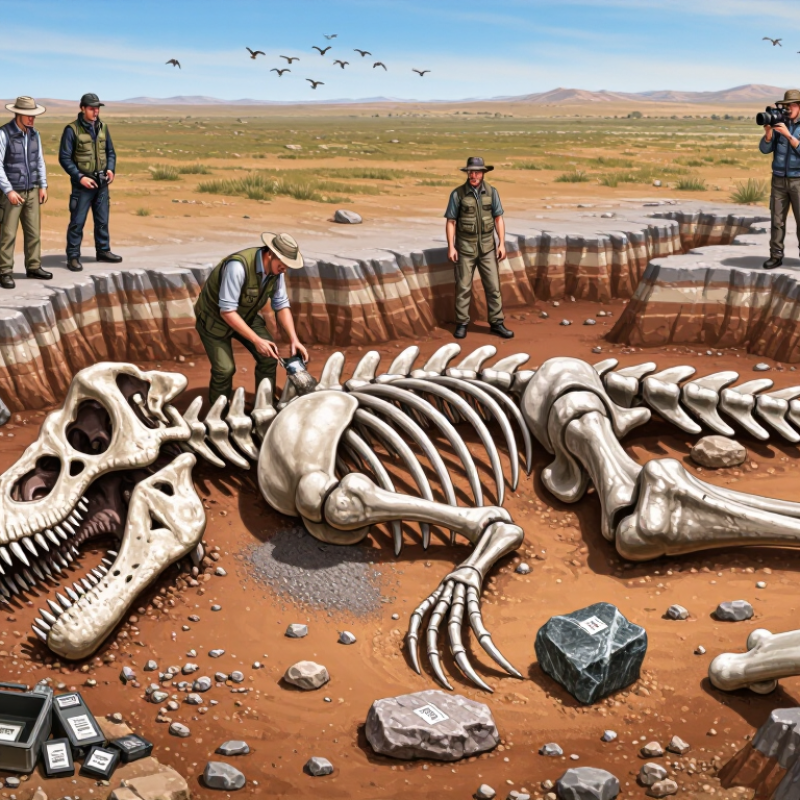
Dinosaur fossils begin with burial, not discovery. A dead animal must be covered quickly by mud, sand, or volcanic ash. This limits scavenging, oxygen, and physical decay. Groundwater then carries minerals through porous bone. Over thousands or millions of years, those minerals replace the original tissues. The result is stone shaped like bone, often heavier and more brittle.
Trace fossils form differently. Footprints, tail marks, nests, and coprolites preserve behavior rather than skeletons. A 2023 Paleobiology Database release contains millions of fossil-occurrence records, showing how widely scientists compare fossils across rock layers. Yet the record remains uneven. Floodplains may preserve many footprints, while forests often leave almost none. Absence is not proof of absence.
Researchers source specimens through measured field surveys, stratigraphic mapping, and careful excavation. They record the exact layer, rock type, orientation, and nearby fossils. These details can reveal whether bones stayed together or moved after death. Radiometric dating of volcanic layers may bracket the fossil’s age, while microscopy tests mineral replacement. The U.S. Geological Survey’s geologic mapping guidance emphasizes location, context, and repeatable documentation. Context matters more than a dramatic bone.
A perfect fossil is rare. Mistakes happen. Even experienced teams can misread fractured rock or disturbed sediment. That uncertainty should remain visible in the record. A fossil tells a story, but the surrounding rock tells us how much of that story deserves trust.