
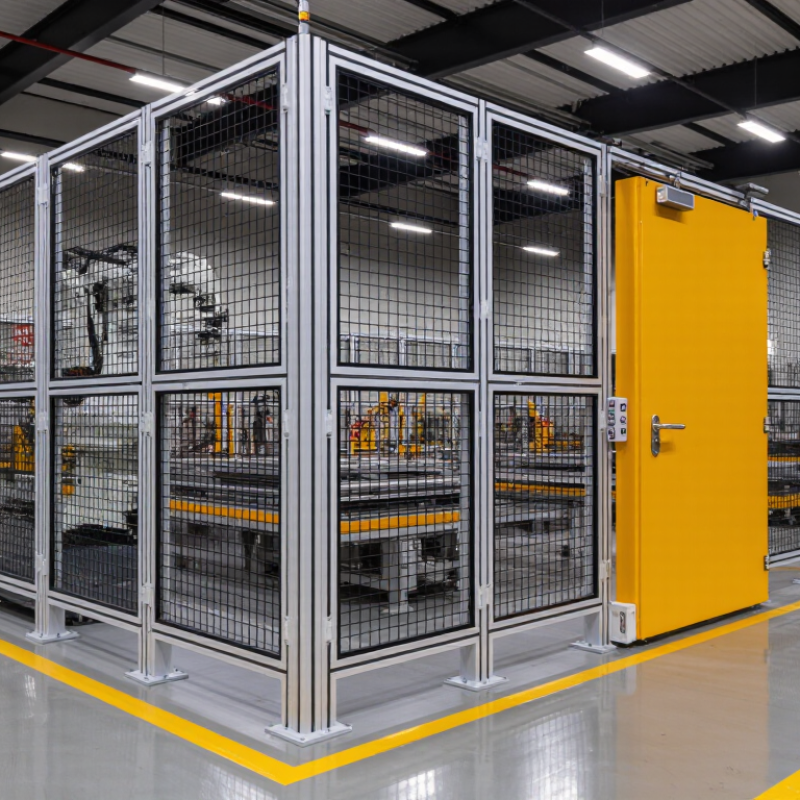
How to Choose the Right Robo Safety Fence?
Industrial robot cells are expanding quickly. The International Federation of Robotics reported 541,302 industrial robots installed worldwide in 2023. A suitable safety fence must therefore support both present risks and future production changes. Begin with a documented risk assessment under ISO 12100. Verify fence height, openings, reach distances, and access points against ISO 13857. Gates should use monitored interlocks, and emergency stopping functions must be tested under realistic operating conditions. A visual inspection is not enough.
Installation Quality
Installation quality matters. Check anchor bolts, panel alignment, sharp edges, electrical bonding, and clear separation from moving equipment. Confirm that bypassing an access gate cannot restart the robot cell. Validation should follow the safety-control requirements of ISO 13849-2, with test results, measured stopping times, and sign-off records retained. Small details matter. A poorly positioned gate can create a hidden reach-through gap.
Maintenance and Expansion
Maintenance should include scheduled inspections of hinges, locks, mesh panels, cables, sensors, and warning signs. Record every repair and retest after software, tooling, or layout changes. OSHA’s enforcement data consistently lists machine guarding among frequently cited workplace safety issues, showing why routine verification cannot become paperwork only. For expansion, reserve floor space, spare mounting points, accessible cable routes, and safety-control capacity. Modular panels can reduce disruption. Still, future compatibility is never automatic. A larger robot, new gripper, or altered path may invalidate the original assessment. I would not trust a perfect checklist after an imperfect modification.