
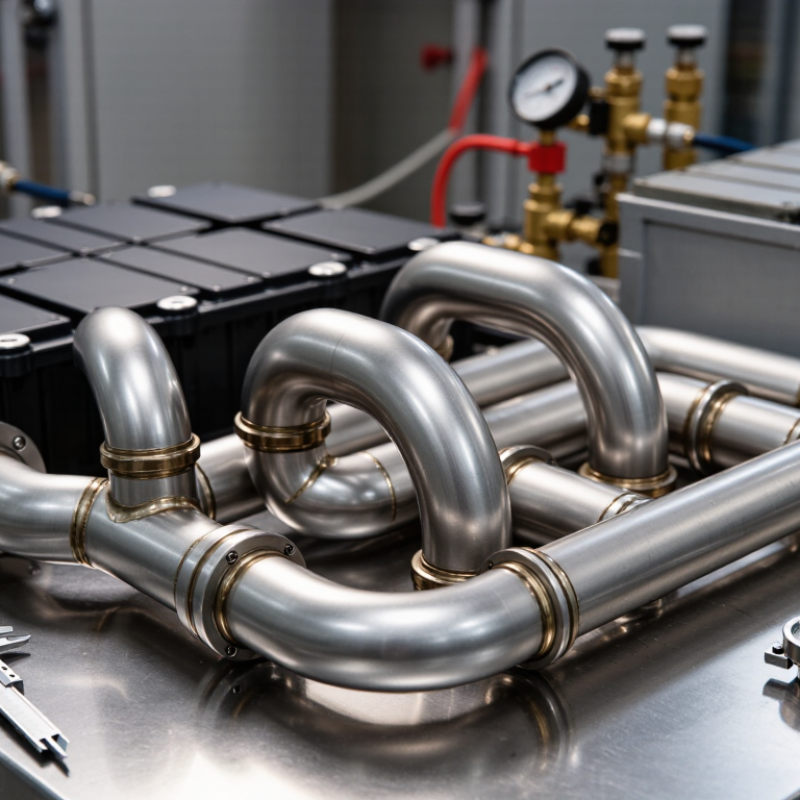
China Best Battery Liquid Cooling Pipe Manufacturers?
Material choice must follow the battery cell format, coolant, pressure, and service environment. The IEA Global EV Outlook 2024 reports that electric vehicle battery demand reached about 750 GWh in 2023. Thermal control is no longer a minor design detail.
Aluminum pipes suit prismatic and pouch battery packs well. They offer low weight, strong heat transfer, and easy integration with stamped cooling plates. Stainless steel handles higher pressure and harsher coolant conditions. It weighs more, though.
Polyamide and EPDM hoses support tight bends around cylindrical modules. Their flexibility helps reduce vibration damage. However, engineers must verify permeation, aging, and coolant compatibility.
Serpentine channels create uniform cooling across long modules. Parallel channels reduce pressure loss but need balanced flow. Brazed aluminum assemblies suit compact packs with high production volumes. Modular manifolds suit serviceable systems, but they may add joints and leak risks.
The best design is rarely the most complex one. I have seen small connector choices undermine an otherwise excellent cooling circuit.
Tips: Match pipe diameter to pump capacity and required flow. Test thermal cycling, vibration, pressure, and chemical compatibility together. The U.S. Department of Energy’s Vehicle Technologies Office emphasizes durability and efficiency in advanced battery systems. Do not rely on room-temperature tests alone. A coolant that behaves well in a laboratory may perform differently after years of heat exposure.