
How to Buy Legal Animal Specimens in 2026?

Buying a legal animal specimen in 2026 is less about finding a striking display and more about verifying its history. A seller’s label is not proof. Buyers should ask for the scientific name, source, acquisition date, and documents showing lawful origin. For international trade in species covered by CITES, relevant permits and certificates may be required. National and local rules can add further restrictions, even for older specimens.

The risks behind poor documentation are real. UNODC’s World Wildlife Crime Report 2024 examined seizures involving roughly 4,000 wildlife species across 162 countries and territories from 2015 to 2021. Those figures describe reported seizures, not the legal specimen market. Still, they show why careful sourcing matters. The CITES Trade Database can help researchers review reported international trade in listed species, but it does not replace permits or advice from wildlife authorities.

For a responsible purchase, choose sellers who provide traceable records and welcome verification. Confirm that the specimen’s identity and paperwork match, and check rules with the competent authority before paying or importing it. Keep invoices and certificates with the item. Small details matter. A faded tag, a vague “estate find” claim, or a missing scientific name deserves follow-up—not assumptions. “Aniaml Specimen” searches may lead to varied listings, so buyers should use precise terms and assess each item independently. Documentation can be tedious. It can also reveal gaps, and walking away may be the wiser choice.
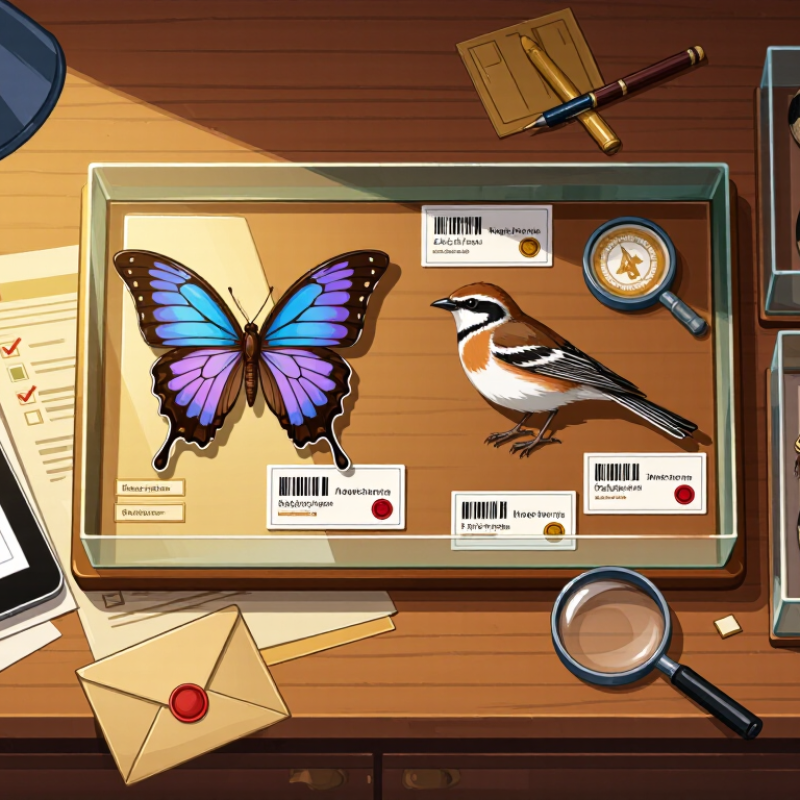
How to Buy Legal Animal Specimens in 2026?

Define the Specimen and Identify Its Legal Status

Before comparing prices, define the specimen precisely. Is it a complete skeleton, a single naturally shed feather, a shell, or a taxidermied animal? Record the scientific name, not just a seller’s common name. Similar-looking species can have different protections. Ask for the specimen’s origin, collection date, and proof of lawful acquisition. Details matter. A clear invoice and provenance record help distinguish a documented specimen from one with uncertain history.

Then check the species and the item’s legal status in every relevant jurisdiction. CITES’ Species+ database lists more than 40,900 covered species, including roughly 6,600 animal species. Coverage does not make every specimen automatically prohibited or automatically saleable; controls can depend on the species, its CITES Appendix, origin, and type of transaction. National and local rules may add separate requirements. Confirm current requirements with the relevant wildlife authority before payment, and keep written guidance with the purchase records. If the seller cannot identify the species or explain its documented origin, pause. I would not treat a confident description as evidence; that is an easy mistake to make.

Check Wildlife Laws and Permit Requirements in Your Region

Before buying a legal animal specimen, check the rules where you live and where it was sourced. Requirements can change with the species, its origin, and whether it will cross a border. CITES Secretariat species records cover more than 40,900 species, including roughly 6,600 animal species. That figure signals broad oversight, not one universal permit rule.

Ask for the specimen’s scientific name, source, collection or breeding records, and a detailed receipt. Compare those details with guidance from your national wildlife authority and local regulators. Check rules for possession, transport, display, and taxidermy separately. A domestic purchase may face additional requirements if you move it across a state or national border.

Keep copies of permits and seller records with the specimen, not in a forgotten email folder. If the paperwork uses vague descriptions, request clarification before paying. “Antique” or “educational” is not a substitute for provenance. Requirements can be confusing, and a seller’s assurance may not settle the question. When details remain unclear, pause and ask the relevant authority for written guidance.

Verify the Seller’s Credentials and the Specimen’s Provenance

When buying a legally sourced animal specimen, verify the seller and the specimen separately. Ask for registration details, relevant qualifications, and an invoice naming the specimen precisely. Match its scientific name, preparation type, and acquisition date across the records. Paper matters. Request provenance documents showing where and when it was collected or acquired, who handled it, and how ownership changed. Where permits or trade records apply, confirm reference details with the issuing authority. Requirements vary by location.

Treat vague origins as a reason to pause. A neat invoice can still leave gaps. The IUCN Red List’s 2024 update assessed 163,040 species and identified 45,300 as threatened, underscoring the value of accurate identification. Check that labels and photographs match the documents, including markings, measurements, and locality details. Keep copies of correspondence and receipts. For uncertain identification, ask an independent curator or qualified taxonomist to review the records. If the seller cannot explain a missing date or conflicting locality, consider a better-documented specimen. This safeguard is useful, but not perfect.

How to Buy Legal Animal Specimens in 2026? - Verify the Seller’s Credentials and the Specimen’s Provenance

Verification area What to request or check How to assess it Warning signs
Seller’s legal identity Request the seller’s legal name, business address, and any wildlife-dealer or taxidermy permits required where the seller operates. Check permit requirements with the relevant national, state, provincial, or local authority. Confirm that the permit is current and covers the activity being offered. A seller refuses to identify themselves, provides unverifiable documents, or claims that no rules apply without explaining why.
Species identification Obtain the accepted scientific name, common name, specimen type, and any available identification report or collection record. Compare the identification with authoritative taxonomic references and applicable protected-species lists. Seek an independent expert opinion when identification is uncertain. Only a vague common name is supplied, or the species description conflicts with the paperwork or photographs.
Collection and acquisition history Ask when and where the specimen was obtained, how it was acquired, and for records linking each transfer to the next owner. Look for a consistent, dated chain of custody, such as invoices, transfer records, collection permits, or institutional accession records where applicable. The origin is described only as “old,” “estate,” or “found,” with no supporting records or verifiable dates.
CITES status and documents For a CITES-listed species, request applicable permits or certificates and confirm the specimen’s source, purpose, quantity, and identification match the item. Check the species’ current CITES listing and consult the relevant CITES Management Authority. Appendix I international commercial trade is generally restricted; Appendix II and III trade also has applicable documentation requirements. A document appears altered, refers to a different specimen or quantity, or is presented as automatically authorizing every future sale or shipment.
Domestic protected-species rules Check national and subnational rules governing possession, sale, transport, import, and export of the species or specimen parts. Ask the relevant wildlife authority whether the proposed transaction is allowed in both the seller’s and buyer’s locations. Rules can differ by jurisdiction and specimen type. The seller treats a CITES document, an old invoice, or a “captive-bred” claim as a substitute for all other required permissions.
Import, export, and shipping Before payment, identify the route, destination, carrier requirements, customs declarations, and any required wildlife or sanitary documents. Confirm requirements with the authorities in the export and import jurisdictions. A permit for one leg of a journey may not satisfy requirements for the other leg. The seller proposes mislabeling the parcel, omitting the species name, or declaring the specimen as a gift to avoid inspection or fees.
Document-to-specimen match Request clear photographs and an item description, including distinguishing features, specimen parts, labels, and permit or accession numbers. Match the paperwork to the actual item before purchase and again upon delivery. Keep copies of all records and correspondence. Photos are generic, identifiers are missing, or the seller will not confirm that the documents correspond to the exact specimen.
Payment and written terms Get a dated invoice stating the specimen’s description, price, seller details, legal documentation supplied, and return or cancellation terms. Use a payment method that provides a transaction record. Make the purchase conditional on receiving and verifying the required documentation. Pressure to pay immediately, cash-only demands, or refusal to provide a written description and receipt.
Final decision Confirm that the seller is identifiable, the specimen is accurately identified, the provenance is documented, and all required permissions are in place. If legality remains uncertain, pause the transaction and seek written guidance from the relevant wildlife authority or a qualified legal professional. Any unresolved inconsistency in species identity, origin, permit validity, or transfer history.

Requirements vary by species, specimen type, and jurisdiction. Verify current rules with the competent authorities before buying, possessing, transporting, importing, or exporting a specimen.

Select a Compliant Specimen and Document the Purchase

How to Buy Legal Animal Specimens in 2026?

Select a Compliant Specimen and Document the Purchase

A compliant purchase starts with a clear identity and traceable origin. Ask for the specimen’s scientific name, source, acquisition date, and the seller’s written description. Confirm that its origin and intended use meet the rules where it was collected, sold, and received. Requirements vary. Do not rely on a label alone.

Documentation matters because conservation pressures are real. WWF’s 2024 Living Planet Report found that monitored wildlife populations declined by an average of 73% between 1970 and 2020. That figure is not a measure of the specimen trade, but it is a strong reason to check provenance carefully. Keep the dated invoice, seller details, transport records, and any permits or transfer documents that apply. Paperwork can feel tedious. It is easy to miss a detail, so verify names and dates before paying.

Tips: Match documents to the actual specimen, not just a similar item. Save digital and paper copies. If the source or paperwork is unclear, pause and ask the relevant wildlife authority for guidance.

Plan Legal Transport, Storage, and Long-Term Care

Choose a specimen only when its species, source, and intended use are clearly documented. Ask the seller for an invoice, origin details, and written care instructions. Check rules for your location, destination, and any transit points before paying. Carrier requirements can differ. Keep copies of relevant documents with the shipment, not buried in email. Small detail, big relief.

Plan delivery for a day when someone can receive the parcel promptly. Use packaging suited to the specimen’s condition, and avoid leaving it in a hot car or freezing porch. If temperature control is required, follow the supplier’s instructions rather than guessing. On arrival, photograph the packaging and specimen, then check for damage before storing it. It is easy to overlook a cracked case when the parcel looks fine.

Storage needs vary. A dry mounted specimen, a sealed teaching sample, and another preserved object may need different conditions. Follow documented guidance, keep the item away from direct sunlight, damp walls, food-preparation areas, children, and pets. Label the container with its identity and acquisition date. Set a monthly reminder to inspect it for fading, moisture, loose fittings, or unusual odor. Plans change. I would also review local requirements before moving it to another home or institution; assumptions age poorly.

Article Source: