
Sesame Grey Granite is valued for its balanced grey background, fine dark grains, and practical versatility. Yet the name does not guarantee a uniform appearance. Quarry location, mineral distribution, and block selection can change a slab’s tone and pattern. Buyers comparing 2026 options should assess actual samples, not rely on product names alone.
Reliable sourcing starts with evidence. The USGS Minerals Yearbook’s dimension-stone coverage provides production and trade context, while UN Comtrade records international merchandise flows under relevant stone classifications. These sources help buyers examine supply patterns, but they do not predict the quality of an individual quarry or shipment. Check quarry details, slab photographs, finish specifications, and recent inspection records. Small differences matter.
Look closely. A polished sample may appear darker than a honed one, especially under warm showroom lighting. This guide compares leading Sesame Grey Granite types by visual character, common applications, and purchasing considerations. It also highlights questions worth asking about thickness tolerance, fissures, resin treatment, and batch consistency. Some variation is natural—and sometimes inconvenient. That deserves an honest discussion before ordering. The goal is not to name one universal “best” type, but to help global buyers match verified material to project requirements and make more informed comparisons.
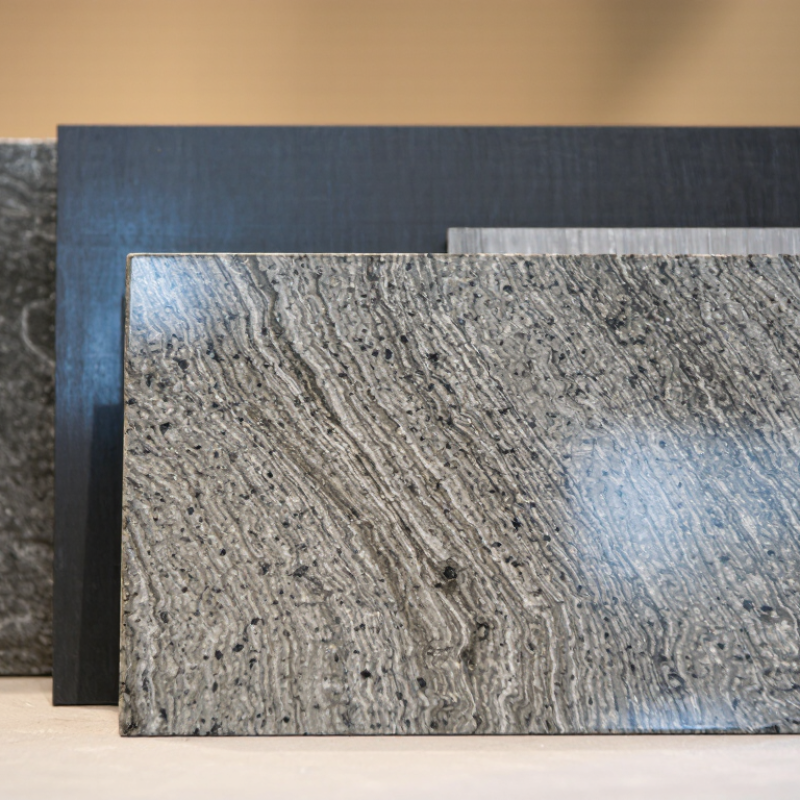
Sesame grey granite is recognized by its peppered surface: pale grey feldspar and quartz sit beside darker mineral grains. Depending on the quarry face, those dark grains may include biotite or amphibole. The pattern can look fine and even from a distance, then reveal larger flecks up close. Subtle shifts matter.
“Sesame grey” is a trade name, not a precise geological specification. Suppliers may use it for stones with different grain sizes, grey tones, or mineral proportions. One batch may appear cool and silvery; another may lean warmer, with beige specks. Ask for the quarry location and a current production sample. Check several slabs, not just a polished chip. Lighting changes the color. So does the finish.
For project approval, compare the sample with the intended finish and inspect it under both indoor and outdoor light. Look for veining, open pits, and variation between slabs. A polished surface can deepen the contrast, while a flamed finish often softens it. Even careful selection has limits: natural stone will not repeat like a printed pattern. That variability is part of its character, but it can complicate matching later deliveries. Record the approved range in writing, and keep a reference piece.

G603 is typically a light sesame grey, with a fine, speckled surface suited to bright interiors and large exterior façades. G654 generally appears darker, with stronger contrast between mineral grains. Quarry location, block depth, and finishing can shift both colors. These names are commercial labels, not perfectly consistent geological grades. Color names are imperfect; even nearby slabs may differ.
For specification checks, ASTM C615/C615M sets granite benchmarks including maximum water absorption of 0.40%, minimum density of 2,560 kg/m³, and minimum compressive strength of 131 MPa. These figures are reference limits, not guarantees for every shipment. Ask for recent test results from the actual quarry lot. Light-to-dark grey variants can also vary in grain size and veining, so review dry and wet samples under the project’s lighting.
Tips: Compare several slabs side by side, then inspect the edges and surface finish. A small sample can hide variation across a full container.
Sesame grey granite ranges from fine, evenly speckled slabs to coarser stone with visible black and white grains. For global buyers, appearance is only part of the specification. Under the stated ASTM C615 benchmark, density should be at least 2,560 kg/m³, while water absorption should not exceed 0.40%. These figures help assess compactness and moisture uptake, but they do not guarantee identical performance in every application.
Request a recent test report tied to the quarry lot or production batch, and confirm the units, test method, and applicable standard edition. A showroom sample can look uniform while a full shipment shows shade variation. That happens. Inspect several slabs under consistent lighting, and compare calibrated thickness and finish before approving production. For exterior paving or wet areas, low absorption is useful, yet installation, drainage, and freeze-thaw exposure still matter. I would not rely on a stone name alone; “sesame grey” is a trade description, not a fixed geological grade. Keep an approved reference sample, and record acceptable color variation in the purchase specification.
ASTM C615 benchmark limits: equivalent density ≥2,560 kg/m³ and water absorption ≤0.40%.
The chart shows specification limits, not test results for individual Sesame Grey granite varieties. The density figure is an approximate conversion of the ASTM minimum specific gravity of 2.56, using water density of 1,000 kg/m³. Confirm compliance with test reports for the specific stone.
2026 Top Sesame Grey Granite Types for Global Buyers
Strength Check: ASTM C615 Compressive Strength ≥131 MPa
Sesame grey granite offers a practical balance of fine speckling and durable performance. Under ASTM C615, the stated compressive-strength benchmark is at least 131 MPa. That figure helps buyers compare stone, but it is not a guarantee for every slab. Quarry variation matters. Request a recent, traceable test report for the specific lot, and confirm the test method and sample condition.
In use, compressive strength indicates resistance to crushing under load. It does not alone predict performance in every application. A countertop edge, a thick paving slab, and a façade panel face different stresses. Ask for relevant test results, including water absorption and flexural strength, and have a qualified designer check thickness and support details. Small differences in grain and mineral distribution can affect appearance, too. One number can mislead.
Tips: Match the report to the shipment lot, not just the stone name. Check that the tested material resembles the selected finish and thickness. For exterior projects, discuss local freeze-thaw exposure with your stone professional. Keep the paperwork. It is easy to overlook.
Sesame grey granite suits projects that need a calm, natural surface rather than a uniform color. Its fine grey background may include darker flecks, pale mineral threads, and subtle shifts between blocks. A polished finish brings out depth and works well for interior counters or feature walls. Honed stone looks quieter under bright lights, though fingerprints and water marks may show differently. Flamed or brushed finishes add texture for outdoor paving. Small details matter.
Tips: View a full slab in daylight, not just a small sample. Ask for finish-specific care guidance and current slip-test information before choosing paving.
Choose slab thickness and edge details to match the installation, and check that the pattern flows across adjoining pieces. For tiles, confirm actual dimensions, thickness, and shade range; even one batch can vary. Outdoor pavers need a suitable base, drainage, and a finish suited to local conditions. These checks are easy to overlook. I would not assume that a textured surface is automatically safe when wet. Request recent project photos or inspect pieces from the shipment, then approve a sample layout before fabrication.
| Commercial Type | Typical Appearance | Suitable Finishes | Common Formats and Thicknesses | Typical Applications | Buyer Selection Notes |
|---|---|---|---|---|---|
| Light Sesame Grey (G603-type) | Light to medium grey background with fine, evenly distributed darker and lighter mineral grains. Appearance can vary by quarry and production batch. | Polished, honed, flamed, bush-hammered | Slabs: approximately 2,400–3,200 × 1,200–1,900 mm, commonly 20 or 30 mm thick. Tiles: common modular sizes include 300 × 300, 600 × 300, and 600 × 600 mm. | Interior floors, wall cladding, countertops, stair treads, and exterior paving when an appropriate textured finish is selected. | Ask for current photographs or a sample from the production lot. Confirm whether the requested color range matches the supplier’s specific G603-type material. |
| Medium Grey Sesame Granite | Balanced grey tone with a visible salt-and-pepper grain; grain size and contrast depend on the source block. | Honed, flamed, brushed, bush-hammered | Slabs: generally supplied in project-specific dimensions, often around 20 or 30 mm thick. Tiles: commonly 300 × 600 or 600 × 600 mm. Paving: often 600 × 300 or 600 × 600 mm. | Commercial flooring, façade panels, steps, landscape paving, and public-realm projects. | Specify the acceptable color range, grain appearance, thickness tolerance, edge detail, and finish in the purchase documents. |
| Dark Sesame Grey (G654-type) | Dark grey to charcoal-grey appearance, usually with contrasting lighter mineral grains. Shade and texture differ among source locations and blocks. | Flamed, honed, leathered, bush-hammered, polished | Slabs: commonly available in 20 or 30 mm thickness, subject to block size. Paving: 20–30 mm is common for many pedestrian applications; thicker material may be specified for heavier-duty use. | Exterior paving, steps, kerbs, building cladding, and interior floors where a darker stone is desired. | For outdoor walking surfaces, request a textured finish and assess slip performance for the intended conditions. Do not assume polished stone is suitable for wet or exposed paving. |
| Fine-Grain Grey Granite | Relatively fine, compact-looking mineral grains create a more uniform appearance than strongly mottled varieties. | Honed, flamed, polished, brushed | Cut-to-size tiles and slabs are available in project-specific dimensions; common interior tile thicknesses are around 10–20 mm, while exterior paving is often 20–30 mm. | Interior wall and floor finishes, counters, stair components, and coordinated indoor-outdoor projects. | Check the finished sample under the project’s lighting. A polished finish can make grain and color variation appear different from a honed or flamed finish. |
| Coarse-Grain Grey Granite | More prominent mineral grains and a visibly varied surface; individual slabs may show noticeable differences in pattern and tone. | Polished, honed, flamed, bush-hammered | Typically supplied as slabs or cut-to-size pieces. Thickness and maximum dimensions depend on the block, fabrication method, and transport requirements. | Feature walls, large floor areas, exterior cladding, landscape paving, and architectural details. | Review slab-by-slab images or a representative bundle when visual consistency matters. Agree on allowable variation before production. |
Specification note: “Sesame Grey” is a commercial color description rather than a single universal geological grade. Names such as G603-type and G654-type are used in trade, but color, grain, available sizes, and performance can vary by quarry and batch. Confirm dimensions, finish, tolerances, and current test results with the supplier for the specific material being purchased.